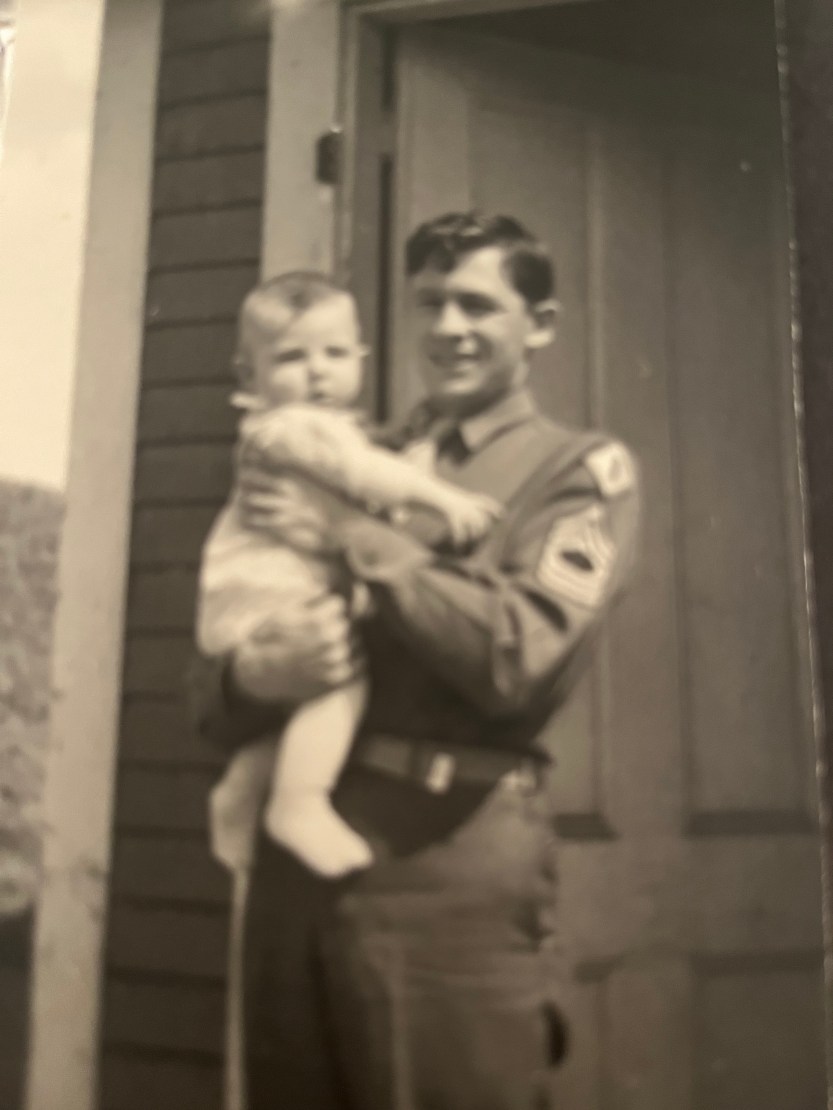
As the eldest grandchild and only grandchild for ten years, I was fortunate to have lavished on me the constant love and attention of my grandfather, Allen Pearl Moran. I was his constant companion during family holidays in Maine and when he would visit us on the prairies of South Dakota. His stories made me laugh, and as I grew older, he told me the stories hidden deep in his memory, eliciting tears.
Born in 1917 in Aroostook County, Maine, at the tail end of World War One, Allen was born into a farming family. His father, Arthur Moran, was an Irish Catholic, and his mother, Lura Carter Moran, was a Methodist farm girl from Penobscot Bay. Theirs was a large family and a fun family. The children loved playing pranks on each other, which continued until their senior years. When the KKK came to the Moran home in the mid-1920s, Arthur boldly shooed them away. Several years later, the Moran family decamped and moved to Ellsworth. The family farm, still standing today but in different hands, sits next to Route 1, just a short drive into town or to the shore.
Allen loved baseball. He and his brothers, Clifton and Glenn, played any chance they got. They were big Boston Red Sox fans, and Clifton made it to the farm team for the Red Sox. Allen always had his mitt on him, often to the consternation of his wife, Glenna. If he saw a pick-up game taking place, he would pull over on the side of the road, grab his mitt and ask if he could play, leaving his young family to amuse themselves! Allen took a different route from his forebears, becoming a bank clerk. He found work in Rangeley, Maine, renting a room from a widow. She attended the Free Baptist Church, so Allen went with her. As he looked up in the choir loft, he saw an angel. Well, that’s how he told the story! The angel’s name was Glenna Huntoon, and he quickly came courting.
Allen and Glenna were married in March of 1941 during a horrible blizzard. He went to Basic Training in Ft. Benning, Georgia, where they used wooden guns. He was assigned to the 71st ID. The 71st was known as the Ring of Fire, and Allen was always very proud that he served with them. He rose to the rank of Master Sergeant due to his dependable nature and dedication to the cause. While in the 71st, he traveled through France, Germany, and Austria. The 71st liberated the Gunskirchen Concentration Camp. When asked about this, Allen would wave his hand and say, “It was horrible.”
The war did not curtail Allen’s sense of humor and love of pranks. One bitterly cold night Allen and another soldier had to pick up a high-ranking General who had just arrived at the front. Allen couldn’t get warm in the frigid Jeep. He thought quickly and told the General that he would happily trade seats with him and sit in the middle. The General was confused, and Allen quickly said, “The Nazis know that the Americans always put the highest-ranking officer in the middle.” The General demanded Allen take his seat in the middle. Allen rode home in warmth!
Because of the places where he served, Allen had enough points to come home soon at the end of WWII. While on board the ship, there was a court-martial, and Allen was called upon to be the stenographer. The military did not help the soldiers and sailors return to their homes when they reached the States. Thankfully Allen was industrious and began to sell the various German pistols and dress knives he had pulled off SS soldiers, making enough money to return to Glenna. He brought her a pair of silk stockings from France and a bottle of Chanel. She would always laugh about those stockings. They were very short, but it was the thought that counted!
Allen took his civil service test and joined a favorite Colonel at Ft. Williams in Portland, ME, working on shuttering forts in New England that were no longer needed at the war’s end. When that work was done, he went to work for the Internal Revenue Service and enjoyed a gratifying career. Allen was a faithful follower of Jesus Christ and a devoted church member. He and Glenna raised six children, all of whom are faithful in their Christian walk and active members of their churches.
One of Allen’s favorite things to do was walk graveyards. He often took me with him. We would sit on the headstones and wonder about those who lay deep in the earth. It wasn’t until decades later, when he told me the story of how his unit had to hide from the Nazis in a graveyard near the Rhine, using the headstones as protection, and of the boys who didn’t make it, that I realized the emotional significance for him of those graveyard visits.
On December 8, 1993, Allen breathed his last breath on this side of glory and now is with his Savior.
Bibliography
“The 71st Infantry Division During World War II.” Holocaust Encyclopedia: United StatesHolocaust Memorial Museum. https://encyclopedia.ushmm.org/content/en/article/the-71st-infantry-division
Bibliographic Information from the private records of Grace Moran White and Doris Moran Murchie. Ellsworth, Maine.
Photos from private Moran photo albums.
 Beginning To End: All Things History