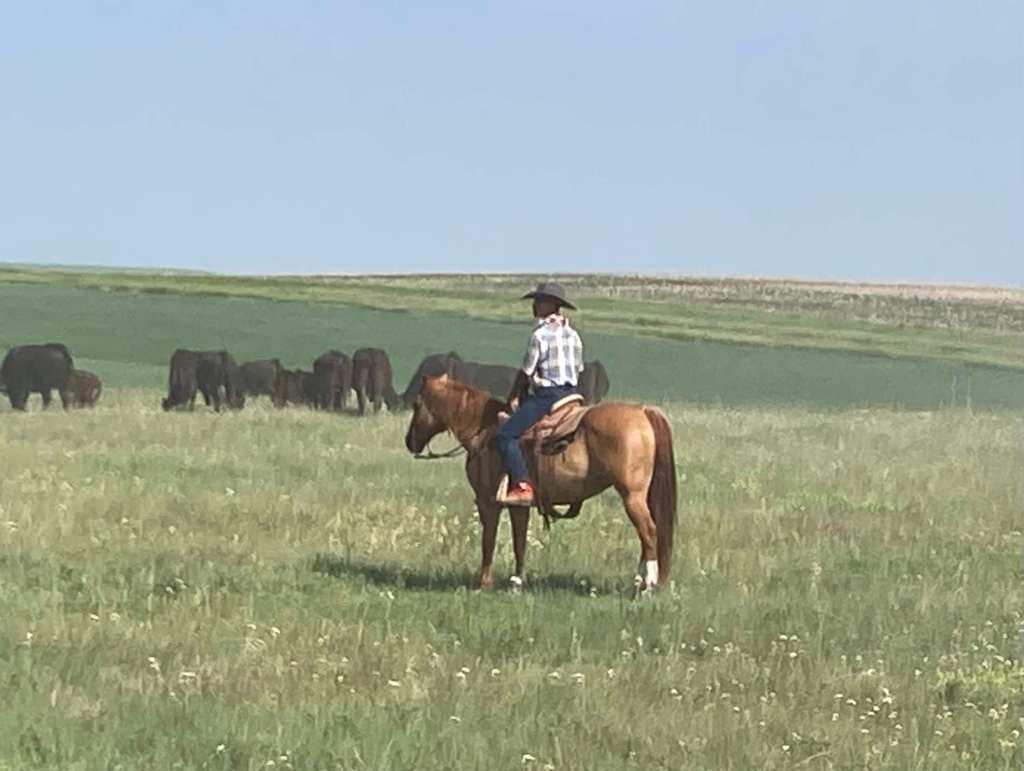
A young man named Moore, from Texas, was highlighted in an article in the St Louis Globe-Democrat, dated April 2, 1883. What garnered Moore this recognition? The author was impressed with the opportunities for wealth and success afforded to Moore because of his interest in the cattle industry. Over two years of hard work as a cowboy on a 150,000-acre ranch in Texas, Moore saved enough money to purchase twenty-one head of cattle and gained permission from his employers to use 640 acres for his fledging herd. In exchange for using the land, he continued to serve as a cowboy and care for his cattle. In a short time, his herd of twenty-one grew to seventy-five head and were valued at twenty-five dollars a head. The author ends his praiseworthy article by stating that if Moore keeps this up, it will just be a few years before he is a rich man with a ranch of his own.[1]
The growth of the cattle industry from mere farm animals to massive herds happened after the Civil War in America. Texas soldiers returning to their farms discovered a cattle populace out of control due to a lack of attention during the War.[2] The entrepreneurs amongst them saw the potential for profitability and began driving the herds into the Dakotas, Montana, and Wyoming. These same herds were then driven to Chicago to the large slaughterhouses, and buyers in the North purchased the meat. The value of cattle rose, enriching the entrepreneurs. The completion of the Transcontinental Railroad in 1869 and subsequent rail lines reaching into the Midwest afforded the ranchers a new source of income: higher-quality beef cattle. Before the genesis of railroad availability, ranchers had to breed their cattle with the inferior Texas Longhorn. The Longhorn had stamina and could make the hundred-mile journey to the train, but it did not contribute to the quality of the meat.[3] By the time Moore ran his herd in 1883, the meat quality had improved, driving up the desire and the price.
The railroad was not the only new technology that positively helped the cattle entrepreneurs. The development of barbed wire and its extensive use on the prairies and grazing lands assisted ranchers in their herds’ containment, enabling them to be more aggressive in their breeding programs. Barbed wire also helped to assuage potential territorial arguments and keep the herds in the right pasturelands.[4] The development of the windmill, allowing ranchers to bring water up from the earth for their herds, also encouraged the cattle industry. Ranchers were no longer beholden to grazing their cattle near rivers and instead could move them away, freeing up more land.[5]
The early 1880s saw a continued cattle boom in the Midwest and Texas. In the earlier part of the century before the Civil War, cattle were moved from the Midwest to the Northwest, into Idaho and Oregon. For a time before 1850, the average farmer owned only five head of cattle, livestock, or swine.[6] However, with the construction of roads and the development of gold mining communities, the cattle industry took off in the Northwest, enriching the pockets of both ranchers and miners. Oregon also began to capitalize on the logging industry, allowing them to profit from ranching, mining, and logging, whereas the Midwest and Texas depended on ranching and farming.
Sadly, in the winter of 1886 and 1887, a most distressing combination of below-freezing temperatures and heavy snow decimated the Midwest and Northwest cattle herds. Prior to these months of grueling cold weather, the ranchers and farmers had enjoyed several years of mild winters and cool summers. However, the summer of 1886 was boiling hot, burning up the prairies so that most of the cattle were starving by November when the snow began to fall. The ranchers and farmers could not store enough hay for their cattle, and during the winter months, millions of cattle perished. Over ninety percent of those cattle out on the open range and prairie were discovered dead and rotting when the spring thaw occurred.[7] In the Northwest, their winter woes continued into the winter of 1889-1890, when another blizzard attacked the Northwest, decimating their herds yet again.[8]
Despite the intense death numbers, the farms in the Midwest and Northwest continued to grow. The Northwest gave up their cattle ranches and switched to raising sheep. The ranchers in the Midwest and Texas focused on herd quality over quantity. In 1850, approximately twelve thousand farms existed in Texas and over one thousand in Oregon. By 1890, Texas had over twenty-two thousand farms, and Oregon, despite several horrible winters, had over two thousand farms.[9]This steady growth trajectory indicates the indubitable spirit of the ranchers and farmers who saw the continued demand from a growing populace regarding the provision of meat and provided it for them, thus providing for their own families.
[1] “A Cowboy Capitalist.” St. Louis Globe-Democrat. April 2, 1883. Vol. 8. Iss. 316. Pg. 4
[2] Gordon Morris Bakken. “Cattle Industry of the American West.” Daily Life Through History. ABC-CLIO, 2023, dailylife2.abc-clio.com/Search/Display/2169926. Accessed 31 Aug. 2023.
[3] Ibid.
[4] Todd Timmons. “Technology on the Cattle Ranch: 19th Century.” Daily Life Through History. ABC-CLIO, 2023, dailylife2.abc-clio.com/Search/Display/1378450. Accessed 31 Aug. 2023.
[5] Ibid.
[6] Gorden Morris Bakken. “Cattle Towns: Northwest.” Daily Life Through History. Daily Life through History, ABC-CLIO, 2023, dailylife2.abc-clio.com/Search/Display/2170245. Accessed 31 Aug. 2023.
[7] Laura Clark. “The 1887 Blizzard That Changed the American Frontier Forever.” Smithsonian Magazine. January 9, 2015. https://www.smithsonianmag.com/smart-news/1887-blizzard-changed-american-frontier-forever-1-180953852/
[8] Gorden Morris Bakken. “Cattle Towns: Northwest.” Daily Life Through History. Daily Life through History, ABC-CLIO, 2023, dailylife2.abc-clio.com/Search/Display/2170245. Accessed 31 Aug. 2023.
[9] Series K 17-18 “Farm Population, Farms, Land in Farms, and Value of Farm Property and Farm Products Sold, but State: 1850-1969.” Bicentennial Historical Statistics of the United States, Colonial Times to 1970.” September 1975. https://www.census.gov/library/publications/1975/compendia/hist_stats_colonial-1970.html
 Beginning To End: All Things History