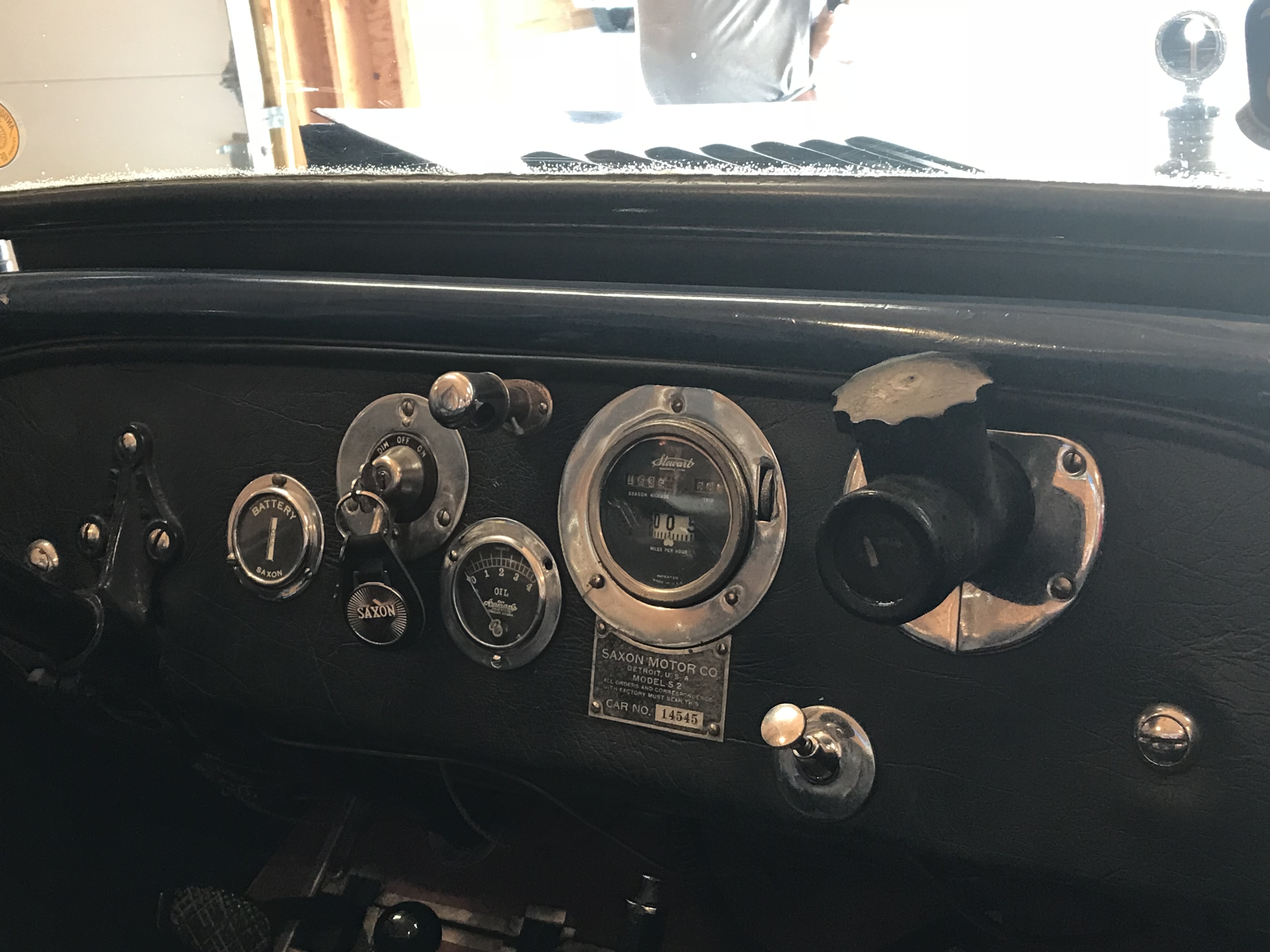
In 1932, an American visionary passed away. His rise to fame was quick, as was his fall, and to this day, he is not a byword in most American homes, unlike his counterpart, Henry Ford. Nevertheless, Hugh Chalmers and his Saxon automobiles left an imprint on the automobile industry by introducing an affordable, trustworthy vehicle that would become known as the woman’s car due to its simplicity in driving and maintenance.[1]
Chalmers dreamed big. He was born in 1873, and at the age of just fourteen, he went to work as an office boy at the National Cash Register Company in Ohio. By 1907, he had amassed enough wealth and risen to the top of National Cash to buy a significant stake in the E.R. Thomas Detroit Motor Company, subsequently changing the name to Chalmers Motor Company.[2] The first Saxon automobile hit the market in 1913, one year before The Great War. The Saxon 4-cylinder two-seater sold for $395. In its first year on the market, 3,000 of them were sold. Their popularity due in part to their ability to go up a hill faster than a Model T[3], made it necessary for Chalmers to move Saxon Motors into a new factory. In 1915, the Saxon 6 went into production, selling for $795.[4] Chalmers touted his seven-passenger vehicle as the most reliable and affordable car on the market, and in 1915, the company boasted a 300 percent growth over the previous year! The Saxon 6 was known for its ease of use and reliability. Some famous owners of Saxons were the Charles Lindbergh family, Bob Jones, the evangelist, and the Mexican revolutionary, General Ortega.[5]
Perhaps one of the most noteworthy owners of a Saxon 4 was the suffragist Mrs. Alice Burke. Burke and her friend, Nell Richardson, left New York City in the spring of 1916 and headed out on a big adventure, sharing the call to give women the vote. Their trip took them across the country, covering 10,700 miles in 178 days! Alice did the driving while Nell attended to the cooking. Each woman had seven speeches prepared, and their dresses matched their car: Suffragist Yellow.[6] The car was christened with a bottle of oil and named “The Yellow Flyer.”[7]
The same year Alice and Nell left on their fantastic journey, Saxon Motor Cars became the eighth most popular manufacturer in the United States.[8] In 1917, 28,000 Saxons were sold in the United States, prompting Chalmers to purchase a larger factory.[9] Economically and growth-wise, this was a solid decision; however, the United States entered the Great War in 1917, affecting peoples’ pocketbooks and desires. 1917, the Saxon Motor Plant burnt down, leaving 1200 men without a job.[10] In the aftermath of the War, Chalmers did not have enough capital to survive the economic depression, forcing the Saxon Motor Company to close its doors ten years after its start. In those ten years, over 100,000 Saxons were built.
Hugh Chalmers was not only a visionary when it came to the Saxon but also to improving the lives of the salesmen who sold the Saxon. Chalmers was concerned that the salesmen were ill-equipped to represent and sell the Saxon. So, he opened a school where salesmen could be trained in all a Saxon offered. They even spent time in the factory itself, watching the cars be put together, with the ability to ask questions of the mechanics and engineers. Chalmers was convinced that not everyone could sell a car, but he would undoubtedly allow them to learn and advance themselves.[11]
By 1919, Chalmers went ahead and agreed to a merger with the Maxwell Motor Company. Chalmers needed to do this to protect his investment with Chalmers Motor Company and keep what he had afloat.[12] In his free time, when he was not running and managing his automobile companies, Chalmers was an active member of the Detroit Detroit Athletic Club and was its first president. He also was the president of the Detroit Board of Commerce.[13] Hugh Chalmers lived the American Dream: coming up from nothing, working his way from an office boy to a stellar motor car and company owner and developer. His trials and triumphs in the early 20th century followed that of many entrepreneurs seeking to get in on the automobile world and seeing how it would revolutionize life in America. Though his Saxon Motor Company lasted only ten years, the imprint was large. To this day, there are Saxon enthusiasts around the United States who have lovingly restored the remaining vehicles to their former glory and use them to teach the new generations about an era gone by.
[1] https://www.conceptcarz.com/vehicle/z7174/saxon-model-14.aspx
[2] “Hugh Chalmers, Auto Maker, Dies: Pioneer in Medium-Priced Car Field Victim of Pneumonia.” New York Times. June 3, 1932. Pg. 19.
[3] “The History of the Saxon Motor Car.” https://www.saxonmotorcars.com/history
[4] Ibid.
[5] Ibid.
[6] Jeryl Schriever. “The Suffragist Saffron Saxon.” https://www.saxonmotorcars.com/_files/ugd/225b9e_18128ccef55c4089b9fa8312bd2cbcc8.pdf
[7] “Saxon to Make Tour.” The Sun. April 30, 1916. Pg. 13A
[8] https://www.conceptcarz.com/vehicle/z7174/saxon-model-14.aspx
[9] Ibid.
[10] “Saxon Motor Plant Burns.” The Sun. Feb. 4, 1917. Pg. SO12.
[11] “School for Salesmen: Chalmers Company To Establish a Course For Training Young Men to Sell Motorcars.” The Sun. September 17, 1916. Pg. 10A.
[12] “Auto Companies Merged.” New York Times. Sept. 5, 1919. Pg. 25.
[13] “Hugh Chalmers, Auto Maker, Dies: Pioneer in Medium-Priced Car Field Victim of Pneumonia.” New York Times. June 3, 1932. Pg. 19.
 Beginning To End: All Things History